Computational Analysis of Social Complexity
Fall 2026, Spencer Lyon
Prerequisites
Julia basics
Outcomes
Understand the basic structure of a Game
Be able to identify any Nash Equilibria in pure strategies for a normal form game
Understand how normal form and extensive form games are related
References
Easley and Kleinberg chapter 6
Introduction
Computational social science analyzes the connectedness of natural, social, and technological systems
Graph theory (networks) has helped us understand how the structure of relationships influence outcomes
We now turn to how behaviors, incentives, and strategies influence choices (and thus outcomes)
The study of how entities make strategic choices in settings where outcomes depend on individual choices and the choices of others is called game theory
Game theory is a very rich topic at the intersection of mathematics and economics
We will study key concepts, but will not cover them in detail or exhaustively
What is a Game?
A game is a description of a strategic environment composed of three elements:
A finite set of players
For each player , a set of feasible actions
Define as action space and as typical element
For each player , a payoff function
To help with notation we’ll focus on two player games (N=2)
We’ll also start by considering that each player has a discrete set of actions (WLOG call them for player )
Basic concepts and definitions can be naturally extended to cases where
Example: Prisoner’s Dilemma
A very famous example of a game is called the prisoner’s dilemma
Story: two robbery suspects brought in for questioning
Investigator immediately separates them and gives both the same deal
If you confess and your partner doesn’t, you go free and he gets 10 years. If you both confess you each get 4 years, and if neither confesses you each get 1 year.
The payoffs for this game can be summarized as follows:
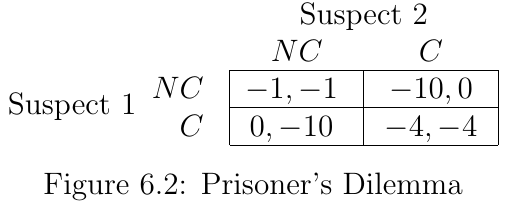

Each table entry has two items
In terms of our definition of a game we have...
N = 2 players
Strategys: for both players
Payoffs as specified in the table
Payoffs as matrices
A common representation of payoffs for a single player is a matrix called the payoff matrix
The row i, column j element gives the payoff when player i chooses the th action in and player j chooses the th action in
For the Prisoner’s Dilemma game above, we have
pd_p1 = [-1 -10; 0 -4]
pd_p2 = [-1 0 ;-10 -4]
2×2 Matrix{Int64}:
-1 0
-10 -4Best Responses
What would happen in the Prisoner’s dilemma game?
You may think that these partners in crime would like to stick together and get a total of 1 year each by not confessing
However, that doesn’t happen
The investigator knows game theory and rigged the game against them...
What should Suspect 1 Do?
Let’s consider suspect 1
pd_p12×2 Matrix{Int64}:
-1 -10
0 -4Suppose suspect 1 believes suspect 2 will not confess
Suspect 1 now faces the first column of
pd_p1and sees he’s better of confessing and getting 0 years instead of -1
What if suspect 1 believes suspect 2 will confess?
1 now faces second column and prefers -4 to a -10, so he still chooses to confess
In either case, suspect 1’s best response is to confess
Because confess is always a best response, we call it a dominating strategy (in this strictly dominating because it is always strictly better than not confess)
How about Suspect 2?
If we look closely at suspect 2’s payoffs we see his game is symmetric to suspect 1’s:
pd_p22×2 Matrix{Int64}:
-1 0
-10 -4No matter what suspect 1 chooses, suspect 2’s best response is to confess
The rational outcome is that both players confess and spend 4 years together in prison
Nash Equilibrium
How did this happen? How is it a rational outcome i.e. an equilibrium?
A famous concept in game theory is called Nash equilibrium (after famous economist John Nash)
Definition: A strategy is a Nash equilibrium if is a best response to (everyone else’s actions)
Intuition: A strategy is an Nash equilibrium if after taking into account every one else’s strategies, each player does not want to change their own
Computing Nash Equilibria
There are various algorithms that we can use for computing Nash equilibria
Fow now we will utilize the implementation of these algorithms in the GameTheory.jl package
Let’s load it up and create a version of our prisoner’s dilemma game:
# import Pkg; Pkg.add("GameTheory")using GameTheoryp1 = Player(pd_p1)2×2 Player{2, Int64}:
-1 -10
0 -4GameTheory.jl requires that payoff matrices are always specified from the perspective of the current player
This means that we need to “reorient” suspect 2’s payoffs such that his actions are noted on the rows
Becuase this is a symmetric game, suspect 2’s payoffs from suspect 2’s perspective looks exactly the same as suspect 1’s payoffs from suspect 1’s perspective
We can construct our
NormalFormGamewith two copies of thep1player above
pd_g = NormalFormGame([p1, p1])2×2 NormalFormGame{2, Int64}We can now ask GameTheory.jl to compute the nash Equilibria for us
We’ll use the
pure_nashfunction to do this (we’ll talk about what “pure” means soon)
pd_eq = pure_nash(pd_g)1-element Vector{Tuple{Int64, Int64}}:
(2, 2)As we said before, the only equilibrium outcome to this game is that they both confess
We can see the payoffs each player gets in equilibrium by “indexing” into the game using the strategy array
The two expressions below are equivalent in this case
pd_g[pd_eq[1]...]2-element Vector{Int64}:
-4
-4# ↑ Equivalent to ↓
pd_g[2, 2]2-element Vector{Int64}:
-4
-4Non symmetric games
Not all games are symmetric like the prisoner’s dilemma
Consider the following game
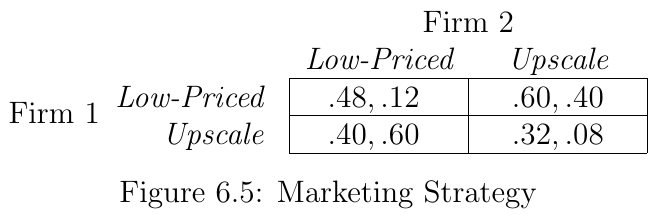
Two players (firms) and two strategies each (sell low price or upscale goods)
60% of total spending comes from people who prefer low prices
Firm 1 more popular, so when they compete in same segment, firm 1 gets 80% of market
Below you find the payoff matrix in units of “% of total possible profit”

Strategies
Firm 1 has a dominant strategy: low-priced. They will always play this strategy
Firm 2 is less clear:
If firm 1 were to choose the upscale market, they would be better off choosing low-priced
however, when firm 1 chooses low-priced, firm 2 best response is upscale
How to find equilbirum?
Iterated Deletion of Dominated Strategies
An algorithm that can help find the solution to this game is called iterated deletion of dominated strategies
The algorithm proceeds as follows:
Set iteration
Let be set of remaining actions for player on iteration . Start
On iteration , for each player remove from any strategies that are dominated by other strategies in (taking into account ). Call surviving strategies
Repeat for all players
Repeat until one of two conditions is met:
Each player has only one remaining strategy: -- this is NE
One or more players has an empty strategy set
Application to Marketing Game
Applying this algorithm we start with
We see form firm 1 it is optimal to play strategy
1for any choice of firm 2, which causes us to delete2. Now we haveNow firm 2 takes into account that 1 will play
1-- only best response is to play2and we getWe are done!
The unique Nash Equilibrium is for firm 1 to take the low-price segment and firm 2 to take the upscale segment
Exercise
Construct the Marketing Game using GameTheory.jl
Verify that the only pure strategy nash equilibrium is [1, 2]
HINT: don’t forget to write player 2’s payoffs from player 2’s perspective!
p1_market = Player([0.0 0; 0 0])
p2_market = Player([0.0 0; 0 0])
g_market = NormalFormGame([p1_market, p2_market])
2×2 NormalFormGame{2, Float64}Matching Pennies
Consider the payoff matrices for another famous game called Matching Pennies
pennies_p1 = [-1 1; 1 -1]
pennies_p2 = [1 -1; -1 1]

pennies_p1, pennies_p2
([-1 1; 1 -1], [1 -1; -1 1])Question: how many players are there?
How many strategies does player 1 have? Player 2?
More Questions
Does player 1 have a dominating strategy?
How about player 2?
What is player 1’s best response when 2 chooses
T? What about when 2 choosesH?
Pure Strategies
Choosing a strategy outright is called playing a pure strategy
Neither player will always choose
HorTno matter what the other player doesWe can say that there is no Nash Equilibrium in pure strategies
However, for all games we will consider (and most games in general) there is always a Nash equilibrium...
Mixed Strategies
Sometimes players will not be able to play pure strategies in eqiulibrium
In these cases they will need to randomize their behavior
A mixed strategy is a probability distribution over strategies
For example, in the matching pennies game, a mixed strategy is to play
Hwith probabilty 0.5 andTwith probability 0.5It turns out that both players playing this mixed strategy is the unique Nash Equilibrium of the matching pennies game
Intuition: Why does 50-50 randomization work? In equilibrium, each player makes their opponent indifferent between their choices. If player 1 plays H or T with 50% probability each, then player 2’s expected payoff is the same whether they choose H or T (both give expected payoff of 0). This mutual indifference is what sustains the equilibrium - neither player has an incentive to deviate from their randomization.
Mixed Strategies with GameTheory.jl
GameTheory.jl can compute mixed strategy nash equilibria for us
To do that we’ll use the
support_enumerationmethod (support enumeration is the name of an algorithm for computing all NE of a game, in pure or mixed strategies)
Bimatrix
Before we have GameTheory compute our mixed strategy NE, we’ll show one other way to create a
NormalFormGame-- with a payoff bimatrixFor an player game with strategies for each player, a bimatrix is an array of payoffs
For our game, we need a 2x2x2 array
last 2 represents 2 players
first two 2’s represent 2 actions per player
pennies_bimatrix = zeros(2, 2, 2)
pennies_bimatrix[1, 1, :] = [-1, 1]
pennies_bimatrix[1, 2, :]  = [1, -1]
pennies_bimatrix[2, 1, :] = [1, -1]
pennies_bimatrix[2, 2, :] = [-1, 1]
pennies_g = NormalFormGame(pennies_bimatrix)
2×2 NormalFormGame{2, Float64}Notice how when using a bimatrix we can directly read the cells of the normal form game
The (H,H) cell is in position [1,1] and has payoffs [-1, 1]
The (T, H) cell is in position [2, 1] and has payoffs [1, -1]
etc.
This can make it easier to specify payoffs because we don’t have to worry about “player N payoffs from player N’s perspective”
support_enumeration(pennies_g)1-element Vector{Tuple{Vector{Float64}, Vector{Float64}}}:
([0.5, 0.5], [0.5, 0.5])Exercise
Try
support_enumerationwith the other two games we’ve worked withWhat does it give you with the prisoner’s dilemma?
What does it give you with the marketing game?
# TODO: your code AND explanation here